Table of Contents
Introduction: Dune: Part Three movie 2026, The Return to Arrakis.
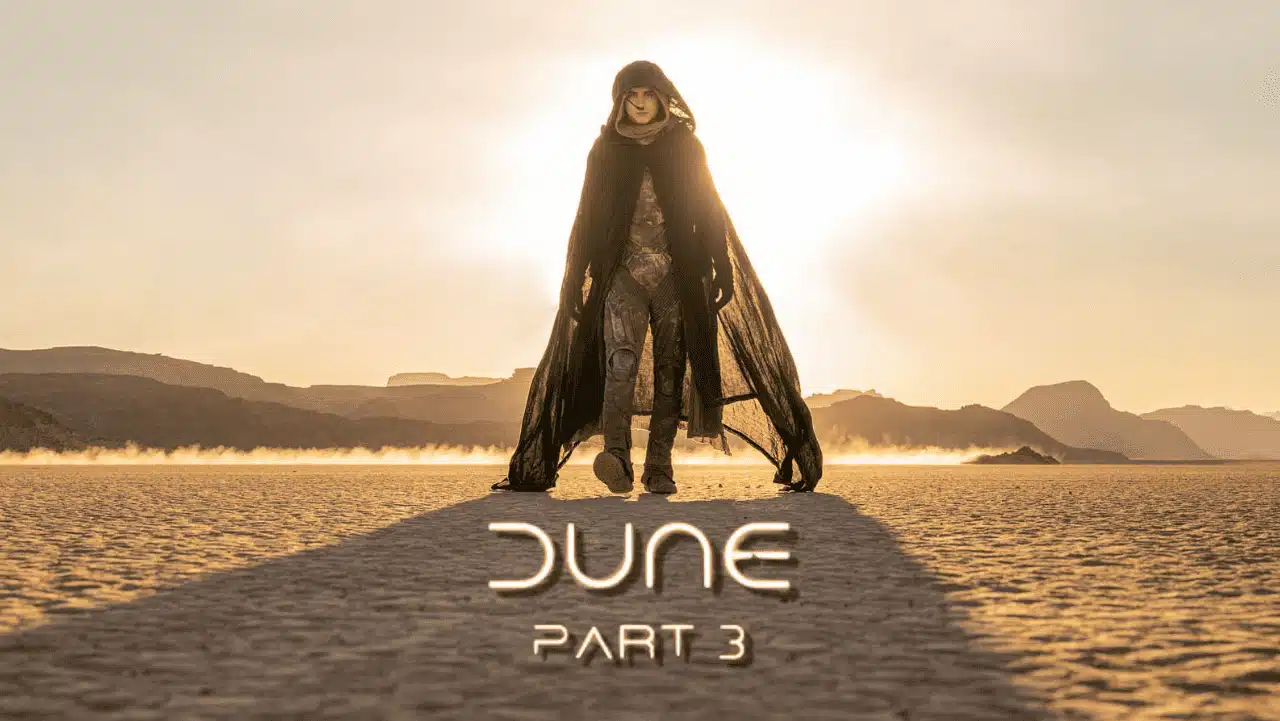
Get ready to return to the endless sands of Arrakis, because one of modern cinema’s most ambitious stories is preparing for its final chapter. After the enormous success of the first two films, both with critics and audiences around the world, Dune: Part Three movie 2026 is moving forward as the highly anticipated conclusion to Denis Villeneuve’s visionary science-fiction trilogy. The Dune: Part Three movie 2026 is expected to deliver an unforgettable blend of spectacle, emotion, and political intrigue as Paul Atreides’ journey reaches its ultimate destination. With expectations higher than ever, fans are eagerly awaiting what promises to be a powerful and dramatic ending to this remarkable cinematic saga.
If the rise of Paul Atreides felt powerful and dramatic, the next chapter promises to be even more compelling. Winning power is only the beginning; maintaining control over a vast empire while facing the consequences of that power is a far greater challenge. As conflict spreads across the galaxy in his name, Paul must confront the heavy burden of leadership and the cost of the choices he has made. More than a traditional science-fiction adventure, this story explores themes of destiny, faith, power, and sacrifice. It presents a deeply emotional and tragic examination of a leader whose heroic image slowly becomes overshadowed by the dangers of absolute authority and the unintended consequences of his vision.
What is Dune: Part Three About?
At its heart, Dune: Part Three movie 2026 is expected to transform the way audiences view Paul Atreides and his journey. While the first two films largely followed the structure of a traditional hero’s rise, showing Paul overcoming immense challenges and avenging the destruction of his family, the Dune: Part Three movie 2026 story’s deeper purpose extends far beyond that familiar narrative. Frank Herbert’s original vision was never simply about creating a triumphant hero; it was a cautionary tale about the dangers of placing too much faith in a single leader.
This final chapter explores the consequences of immense influence and unchecked authority, revealing how even the most admired figures can become trapped by their own power. As the story unfolds, it challenges assumptions about destiny, leadership, and the true cost of becoming a legend.
Adapting Frank Herbert’s Dune Messiah
The story of Dune: Part Three movie 2026 draws heavily from Dune Messiah, Frank Herbert’s acclaimed 1969 sequel that expands and deepens the themes introduced in the original novel. For the Dune: Part Three movie 2026 adaptation, however, Denis Villeneuve and co-writer Brian K. Vaughan have made a notable adjustment to the timeline. In Herbert’s book, the narrative takes place twelve years after Paul Atreides seizes power, but the Dune: Part Three movie 2026 reportedly extends that gap to seventeen years. This additional passage of time allows the consequences of Paul’s rule to feel even more profound and far-reaching.
The Imperium audiences return to is no longer merely adapting to a new emperor—it has been fundamentally reshaped by nearly two decades of Atreides dominance. Political systems, religious movements, cultural identities, and entire worlds have evolved under the influence of Paul’s reign, creating a galaxy that looks dramatically different from the one seen in the previous films. This expanded timeline gives the story greater weight, emphasizing how deeply one leader’s actions can transform civilization and setting the stage for the powerful conflicts that lie ahead.
The Storyline: Power, Prophecy, and Pain
The official synopsis for Dune: Part Three movie 2026 promises a darker and more emotionally complex chapter than anything audiences have seen so far. The story follows Emperor Paul Atreides as he struggles with the consequences of his rise to power while political conspiracies and a devastating holy war spread across the galaxy, threatening the future he alone can foresee. The scale of the conflict is immense, but the Dune: Part Three movie 2026’s true focus lies in the personal burden carried by its central character.
The young man who once fought for survival in the deserts of Arrakis is gone. In his place stands the powerful Padishah Emperor, ruler of the Known Universe and the most influential figure in human history. Yet power has brought Paul neither freedom nor peace. Gifted—and cursed—with visions of possible futures, he is constantly confronted by outcomes that range from catastrophic to apocalyptic. Every decision becomes a painful calculation, forcing him to weigh the survival of humanity against the moral cost of his actions.
As Paul struggles to protect humanity’s future, he becomes increasingly entangled in the forces that elevated him to power in the first place. Destiny, religious prophecy, and the unwavering devotion of countless followers leave him with fewer choices than ever before. To billions across the Imperium, he is more than an emperor—he is a living legend whose every word carries the weight of divine truth. Yet behind that image is a man burdened by fear, doubt, and the knowledge of what may come.
This tension creates the central tragedy of the Dune: Part Three movie 2026 story. Paul understands that preventing a catastrophic future may demand decisions that conflict with his own values and humanity. The further he pushes toward what he believes is the greater good, the greater the risk that he will lose himself in the process. His journey is no longer about gaining power but about surviving its consequences and confronting the moral compromises it demands.
Through this deeply personal struggle, Dune: Part Three movie 2026 is expected to deliver far more than spectacular battles and political intrigue. It promises a thoughtful examination of leadership, faith, and the burden of responsibility, asking whether any individual can wield immense power without being changed by it. The result is a story that explores the fine line between heroism and tyranny, making Paul Atreides one of the most fascinating and tragic figures in modern science-fiction cinema.
Emperor Paul Atreides and the Burden of the Throne
Imagine living with the responsibility of witnessing many potential futures at every turn. Instead of giving him freedom, his vision ensnares him in a never-ending web of repercussions, making it almost impossible to avoid the future he fears the most. Paul has become the focal point of a huge religious movement that spans the galaxy, despite the fact that he never pursued supernatural status. Paul is acutely conscious of his own uncertainties, frailties, and limits while the public perceives him as a strong and unfailing emperor.
Paul realizes that the religious and political forces that elevated him have become uncontrollable as he fights to avert disaster. Dune: Part Three movie 2026 revolves around this conflict, which turns it into a gripping analysis of faith, power, and the terrible results of being a symbol greater than oneself.
The Holy War (Jihad) Across the Cosmos
The ominous future that haunted Paul Atreides throughout the earlier chapters of the story has finally become reality. The warnings, flashes of violence, and visions of a galaxy consumed by fanaticism were never distant possibilities they were signs of a catastrophe waiting to unfold. What Paul once feared as a “terrible purpose” has emerged in full force, reshaping the Known Universe in ways he desperately hoped to avoid.
Across countless worlds, armies inspired by the legend of Muad’Dib have spread the Fremen jihad with relentless determination. Driven by absolute faith and convinced they are carrying out a sacred mission, these followers have transformed a political revolution into a galaxy-spanning crusade. Entire civilizations have been forced to submit to the new order, while those who resisted have faced devastating consequences. The conflict has left deep scars across the Imperium, creating an atmosphere of fear, instability, and unimaginable loss.
What makes this situation especially tragic is Paul’s inability to control the movement that bears his name. Despite being the most powerful ruler in existence, he finds himself trapped by the very myth that elevated him to the throne. The religious fervor surrounding his image has grown far beyond the reach of any single individual, including its reluctant figurehead. As billions act in his name, Paul is forced to witness the destructive consequences of a faith he never intended to unleash.
This painful contradiction underscores one of the story’s most powerful themes: that once belief becomes a force of its own, even the person at its center may be powerless to direct its course. In this way, Dune: Part Three movie 2026 becomes not only a tale of political power but also a profound exploration of responsibility, unintended consequences, and the devastating cost of becoming a living legend.
The Conspiracies in the Shadows
While the galaxy is consumed by war and religious upheaval, an equally dangerous battle unfolds behind closed doors within the heart of the Imperium. Far from the front lines, powerful factions are quietly maneuvering against Emperor Paul Atreides, weaving a network of intrigue, deception, and political manipulation. These forces understand that defeating Paul through open conflict is nearly impossible. Instead, they seek to undermine him from the shadows, attacking the foundations of his power rather than confronting him directly.
The established institutions that once shaped the destiny of humanity have little interest in accepting a future dominated by a single ruler and his prophetic vision. Faced with the growing influence of House Atreides, former rivals and uneasy partners begin to align their interests. The mysterious Bene Gesserit sisterhood, the immensely influential Spacing Guild, and the secretive Tleilaxu each possess their own motives, but they share a common objective: reducing Paul’s control over the Imperium and restoring a balance of power more favorable to their interests.
At the center of this struggle lies the spice Melange, the most valuable substance in the universe and the foundation upon which commerce, interstellar travel, and political authority depend. Paul’s dominance over Arrakis has given him unprecedented leverage, allowing him to shape the future in ways no previous emperor could. For his enemies, breaking that monopoly is essential. If they can weaken his grip on the spice, they can challenge his rule and potentially reshape the course of civilization itself.
This hidden conflict adds another layer of tension to Dune: Part Three movie 2026. Beyond its grand battles and sweeping political drama, the story becomes a sophisticated game of strategy where alliances are fragile, betrayal is constant, and every move carries enormous consequences. As conspiracies tighten around the throne, Paul must confront threats that cannot be defeated through military strength alone, setting the stage for a gripping and deeply personal struggle over the future of humanity.
Denis Villeneuve’s Visionary Direction
With the first two Dune: Part Three movie 2026, Denis Villeneuve established himself as one of the defining science-fiction filmmakers of his generation. By combining breathtaking visuals, meticulous world-building, and genuine emotional depth, he succeeded in bringing Frank Herbert’s famously complex novels to the screen in a way many once believed impossible. His work transformed Dune: Part Three movie 2026 from a long-considered cinematic challenge into one of the most acclaimed and ambitious film sagas of the modern era.
For Villeneuve, however, Dune: Part Three movie 2026 is more than simply the next installment in a successful franchise. It represents the culmination of a story he has been building toward from the very beginning. The director has indicated that this Dune: Part Three movie 2026 will mark the end of his personal journey within the Dune universe, making it his final contribution to the saga. As a result, there is a strong sense that he intends to deliver the most complete and emotionally resonant conclusion possible, bringing years of creative vision to a powerful close.
What makes this chapter especially important is its role in redefining how audiences understand Paul Atreides. The earlier films naturally positioned Paul as a sympathetic protagonist—a young man facing impossible circumstances, seeking justice for his family, and embracing a destiny larger than himself. Yet Frank Herbert’s original intention was always more complex. The story was designed to challenge the idea of the perfect hero and to examine the dangers of placing immense faith in a single charismatic leader.
Villeneuve appears determined to preserve that deeper message. Rather than celebrating Paul’s rise to power, Dune: Part Three movie 2026 is expected to confront the consequences of his transformation and the immense cost of becoming a messianic figure. By exploring the darker implications of leadership, prophecy, and absolute authority, the Dune: Part Three movie 2026 aims to reshape audience perceptions of its central character. In doing so, it promises to complete the thematic journey of the trilogy, turning what began as a heroic ascent into a profound reflection on power, responsibility, and the unintended consequences of creating legends.
The Writing Team: Villeneuve, Vaughan, and Herbert
Bringing a story as layered and intellectually rich as Dune: Part Three movie 2026 to the screen requires more than visual spectacle—it demands a screenplay capable of balancing complex ideas with compelling drama. To achieve that balance, Denis Villeneuve collaborated with acclaimed writer Brian K. Vaughan, whose work across comics and television has earned widespread praise for its strong character development, emotional depth, and intricate worldbuilding. Vaughan’s storytelling strengths make him a natural creative partner for adapting the challenging themes and political complexities that define Frank Herbert’s universe.
The collaboration combines Villeneuve’s cinematic vision with Vaughan’s talent for crafting engaging narratives driven by human conflict and difficult choices. Together, they are tasked with translating a story filled with philosophical questions, religious tensions, political maneuvering, and personal tragedy into a Dune: Part Three movie 2026 that remains accessible to a global audience. This is no small challenge, especially considering that Dune Messiah, the novel serving as the foundation for the Dune: Part Three movie 2026, is more introspective and politically focused than its predecessor.
Early indications suggest that the screenplay seeks to preserve the novel’s rich themes while creating a dramatic and emotionally engaging cinematic experience. The intricate conspiracies, shifting alliances, and moral dilemmas at the heart of the story are expected to remain intact, but they will be presented with a sense of momentum and urgency suited to a large-scale theatrical production. By carefully blending thoughtful character exploration with suspense, action, and political intrigue, the script aims to deliver a Dune: Part Three movie 2026 that is both intellectually satisfying and dramatically compelling.
If successful, this partnership could provide the ideal conclusion to Villeneuve’s trilogy—one that respects the depth of Herbert’s vision while embracing the cinematic storytelling needed to captivate modern audiences. The result has the potential to be a science-fiction epic that is as emotionally powerful and thought-provoking as it is visually spectacular.
A Star-Studded Cast: Who is Returning?
One of the most exciting aspects of Dune: Part Three movie 2026 is the extraordinary ensemble cast brought together to tell this final chapter. Building upon the foundation established by the previous films, the production unites an impressive group of returning performers with a number of highly anticipated new additions. The result is a cast filled with award-winning actors, rising stars, and internationally recognized talent, all contributing to the immense scale and emotional depth of the story.
The returning cast members are expected to bring even greater complexity to characters who have evolved dramatically over the course of the saga. As the consequences of war, power, and prophecy continue to unfold, familiar faces will be tasked with portraying some of the most challenging and emotionally charged moments in the entire trilogy. Their established chemistry and deep understanding of the material provide a strong foundation for the Dune: Part Three movie 2026 dramatic core.
At the same time, new cast additions have the opportunity to introduce fresh energy and perspective into an already rich universe. Many of the characters entering the story play crucial roles in the political conspiracies, ideological conflicts, and personal struggles that drive the narrative forward. Their presence expands the scope of the world while raising the stakes for every major player involved.
Together, this remarkable ensemble helps transform Dune: Part Three movie 2026 into more than just a large-scale science-fiction spectacle. The Dune: Part Three movie 2026’s success will depend not only on its visual grandeur and epic storytelling but also on the performances of the actors bringing these complex characters to life. With such an exceptional collection of talent on screen, audiences can expect powerful drama, memorable character interactions, and the emotional weight necessary to bring this ambitious saga to a satisfying and unforgettable conclusion.

Timothée Chalamet as the Tortured Emperor
At the center of Dune: Part Three movie 2026 stands Timothée Chalamet, who faces what may be the most challenging role of his career. Across the first two films, audiences witnessed Paul Atreides’ transformation from a thoughtful young nobleman into a skilled warrior, revolutionary leader, and ultimately the most powerful figure in the galaxy. The final chapter demands an even deeper evolution, requiring Chalamet to portray a character burdened by power, prophecy, and the crushing weight of responsibility.
Unlike the earlier films, where Paul’s journey was defined by survival and ambition, this story places him in a position of near-absolute authority. As Emperor, he commands vast armies and influences the fate of entire worlds, yet his immense power brings neither peace nor certainty. Instead, Paul becomes increasingly isolated, separated from ordinary human experience by both his political status and his extraordinary ability to see possible futures. Capturing that loneliness while maintaining the character’s commanding presence will be one of the Dune: Part Three movie 2026’s greatest acting challenges.
Chalamet is expected to balance two seemingly contradictory sides of Paul. On one hand, he must embody the almost mythological image of a ruler revered by billions, a figure whose words can alter the course of history. On the other, he must reveal the deeply human fears, doubts, and emotional wounds hidden beneath that powerful exterior. Paul understands the terrible consequences of the path he has chosen, and he carries the knowledge that many of his decisions may lead to suffering, even when made with the intention of protecting humanity’s future.
This internal struggle is likely to form the emotional backbone of the Dune: Part Three movie 2026. Rather than portraying a triumphant conqueror, Chalamet will be tasked with depicting a man trapped by his own legend, wrestling with the consequences of power on a scale few could imagine. If successful, the performance could become one of the defining achievements of his career, bringing depth, vulnerability, and tragic complexity to one of science fiction’s most fascinating characters.
Zendaya’s Chani: A Drastic Narrative Departure
One of the most anticipated emotional threads in Dune: Part Three movie 2026 is the fate of Chani and her fractured relationship with Paul Atreides. At the end of Part Two, Denis Villeneuve made a bold narrative shift by breaking away from the traditional arc of loyalty often seen in epic romances. Instead of standing beside Paul as his consort, Chani portrayed by Zendaya rejects the direction his rule has taken, especially the manipulation of Fremen prophecy and the growing myth of his divinity. Her decision to leave and vanish into the desert signals a deep ideological and emotional rupture that reshapes the heart of the Dune: Part Three movie 2026 story.
Chani’s separation from Paul is not just a personal break; it becomes a powerful moral statement. Where others are drawn into the expanding mythology of Muad’Dib, she remains grounded in lived experience, remembering the cost of belief when it turns into blind devotion. In many ways, she embodies the conscience of the narrative, standing apart from the machinery of empire and refusing to be swept into the tide of religious fervor that now defines the Imperium.
As Dune: Part Three movie 2026 unfolds, the question of how—and whether—their paths cross again becomes central to the emotional tension of the Dune: Part Three movie 2026. Any future encounter between Paul and Chani is likely to carry immense weight, shaped not only by their shared history but by the ideological divide that now separates them. Paul, increasingly isolated within the machinery of prophecy and power, represents the consequences of becoming a symbol larger than life. Chani, by contrast, represents clarity, resistance, and the human cost of that transformation.
Their dynamic promises to be the emotional anchor of the Dune: Part Three movie 2026, grounding its vast political and cosmic stakes in something deeply personal. Through their fractured connection, the story explores love, betrayal, belief, and the painful realization that even the strongest bonds can be reshaped—or broken—by destiny and power. In this way, Dune: Part Three movie 2026 is expected to reach its most intimate and tragic notes not through battles or conspiracies, but through the unresolved relationship between two people who once believed they could change the future together.
Javier Bardem and the Fanatical Fremen
Javier Bardem returns as Stilgar, and his presence once again underscores one of the most unsettling themes at the heart of Dune: Part Three movie 2026: the transformation of faith into something uncompromising and dangerous. Stilgar’s unwavering devotion to Paul Atreides as the Mahdi, once rooted in hope and survival, has hardened into absolute certainty. What began as belief has become identity, and what began as devotion has evolved into a force that shapes violence on a massive scale.
Bardem’s portrayal is expected to carry both emotional weight and quiet tragedy. Stilgar is not written as a simple zealot, but as a man who genuinely believes he is witnessing the fulfillment of prophecy. That sincerity is what makes him so compelling—and so disturbing. His loyalty is not fragile or hesitant; it is total. And in a universe where belief can move armies and erase entire civilizations, that certainty becomes immensely consequential.
Through Stilgar, the story explores how faith can be both sustaining and destructive. He represents the countless followers who interpret divine purpose through human actions, often without questioning the cost. In his eyes, every decision made in the name of Paul carries sacred legitimacy, even when those decisions lead to suffering or devastation. This tension between devotion and consequence sits at the core of his character arc.
As the Dune: Part Three movie 2026 progresses, Stilgar becomes a mirror reflecting the broader tragedy of Paul’s rise. His faith amplifies the myth of Muad’Dib, helping to sustain the very forces that Paul increasingly fears and cannot control. In this way, Bardem’s character is not just a supporter of the Emperor, but a living embodiment of the dangers Frank Herbert warned against—the point at which belief stops being personal conviction and becomes an unstoppable, impersonal force shaping history itself.
Exciting New Additions: Robert Pattinson as Scytale
The ensemble expands significantly in , introducing new layers of intrigue and psychological tension to an already dense political landscape. Among the most striking additions is Robert Pattinson as Scytale, a Face Dancer of the Bene Tleilax whose unsettling ability to assume identities makes him one of the most dangerous figures in the Imperium. His presence introduces an unpredictable and almost spectral quality to the imperial court, where trust becomes fragile and appearances can no longer be taken at face value. As a representative of the Tleilaxu’s secretive ambitions, Scytale operates with quiet precision, embodying manipulation, espionage, and the terrifying elasticity of identity itself.
Equally significant is the expanded role of Anya Taylor-Joy as Alia Atreides, now fully grown and far more prominent within the political and spiritual machinery of her brother’s empire. Possessing extraordinary intelligence and an unsettling awareness that borders on the inhuman, Alia becomes a destabilizing force within the Atreides dynasty. Her presence deepens the psychological tension of the story, as her insight into events—and into Paul himself—challenges the fragile balance between prophecy, power, and sanity. She stands as both family and enigma, a reminder that the consequences of Paul’s rise extend even into the next generation.
Returning as Princess Irulan, Florence Pugh continues to navigate the complex web of loyalty and ambition within the imperial court. Her role as both historian and political operator places her at the intersection of truth and propaganda, where the official narrative of Paul’s reign is constantly being shaped, revised, and weaponized. Irulan’s intelligence and restraint make her a key player in the subtle struggle for influence over the Emperor and the legacy of his rule.
Together, these characters broaden the scope of Dune: Part Three movie 2026, transforming it into an even more intricate study of identity, control, and political survival. With Scytale’s deception, Alia’s unsettling evolution, and Irulan’s calculated maneuvering, the imperial court becomes a pressure cooker of competing agendas—each one pushing against the fragile authority of Paul Atreides in increasingly dangerous ways.

Behind the Scenes: Production Details
A production on the scale of Dune: Part Three movie 2026 demands far more than a traditional Dune: Part Three movie 2026 shoot—it requires a coordinated global operation that blends artistry, engineering, and precision logistics. Bringing the vastness of the Imperium to life means constructing entire worlds from the ground up, both physically and digitally, while ensuring every element feels cohesive within Denis Villeneuve’s carefully controlled visual language.
Behind the camera, production is driven by an international network of designers, location teams, visual effects artists, costume departments, and technical crews working in sync across multiple countries. Practical sets remain a cornerstone of the filmmaking approach, with large-scale desert environments, monumental architecture, and intricately detailed interiors built to immerse actors directly into the world of Arrakis and the imperial court. These tangible environments are then seamlessly extended through visual effects, ensuring that scale never comes at the expense of realism.
Cinematography and production design work hand in hand to maintain the franchise’s signature aesthetic—minimalist yet monumental, grounded yet mythic. Every frame is carefully composed to reflect not only the physical environment but also the psychological weight carried by its characters. Lighting, color palettes, and camera movement are all used deliberately to reinforce themes of power, isolation, and destiny.
Costume and creature design also play a crucial role in expanding the universe. From the weathered stillsuits of the Fremen to the elaborate regalia of the imperial court, each design choice reflects cultural history, political hierarchy, and environmental adaptation. Meanwhile, the creation of beings such as the Face Dancers requires a fusion of practical performance techniques and advanced digital augmentation, pushing the boundaries of character transformation on screen.
At the same time, post-production becomes a global effort of its own. Visual effects studios across continents collaborate to render massive battle sequences, planetary landscapes, and subtle narrative details that would be impossible to capture physically. Sound design and score development further elevate the experience, layering atmospheric depth that transforms each setting into a fully realized world.
Ultimately, the making of Dune: Part Three movie 2026 is as ambitious as its story. It is not just a Dune: Part Three movie 2026 production, but a carefully orchestrated global endeavor—one that reflects the scale of its narrative while maintaining the artistic discipline required to keep its vision grounded, coherent, and emotionally powerful.
Filming in Budapest, Hungary
Principal photography for Dune: Part Three movie 2026 reportedly began in July 2025, with much of the production centered in Budapest, Hungary. The city has effectively become a creative hub for Denis Villeneuve’s vision of Arrakis, offering vast, modern soundstages capable of accommodating the Dune: Part Three movie 2026’s extraordinary scale and design ambitions.
Budapest provides the kind of controlled, expansive production environment needed to construct the imposing imperial world of Paul Atreides. Within these state-of-the-art facilities, filmmakers are able to build enormous practical sets, including the sprawling architecture of the Emperor’s palace—designed to feel deliberately overwhelming, with proportions that dwarf anything found in the real world. The intent is to visually reinforce the psychological weight of Paul’s rule, turning architecture itself into a symbol of power and isolation.
By anchoring production in a location like Budapest, the filmmakers gain both logistical efficiency and creative freedom, allowing them to seamlessly blend practical set construction with large-scale visual effects. This combination helps ensure that the world of Dune remains grounded and tangible, even as it expands into increasingly mythic and operatic territory.
The Musical Score by Hans Zimmer
Arrakis has never been defined by visuals alone—the planet’s identity is inseparable from its sound, and once again that sonic world is being shaped by composer Hans Zimmer. Returning after his acclaimed, Oscar-winning work on the first installment, Zimmer continues to serve as the musical architect of the Dune universe, crafting a score that is as much world-building as it is storytelling.
His earlier work helped establish the franchise’s signature audio identity: an otherworldly fusion of custom-built instruments, distorted human voices, and deep, ritualistic percussion that feels both ancient and alien. Rather than relying on traditional orchestral structure alone, Zimmer built a soundscape that behaves like a living ecosystem—one that breathes, reacts, and evolves alongside the narrative. It became the emotional pulse of Arrakis itself.
For Dune: Part Three movie 2026, the musical direction is expected to shift into even darker territory. As the story descends deeper into the consequences of Paul Atreides’ rise and the devastation of the holy war spreading across the galaxy, the score is likely to reflect that loss of innocence. Where earlier themes carried a sense of awe, discovery, and looming destiny, this chapter is poised to embrace melancholy, tension, and moral weight.
The music will not simply accompany events on screen—it will underscore the emotional collapse at the heart of the story. The grandeur of empire and prophecy is expected to be contrasted with quieter, more haunting motifs that emphasize grief, regret, and inevitability. In this way, Zimmer’s work becomes a narrative force of its own, guiding the audience through the psychological and spiritual consequences of a universe consumed by belief.
As always, the sound of Dune remains inseparable from its meaning. And in Dune: Part Three movie 2026, that sound is set to become more intimate, more sorrowful, and more reflective of a world paying the price for its own myths.
Technical Specifications: A Cinematic Feast
For the cinephiles and tech enthusiasts out there, this Dune: Part Three movie 2026 is being tailor-made for the largest screens possible. Production companies Warner Bros. and Legendary Entertainment have spared no expense.
| Technical Aspect | Specification |
| Color Tech | Premium Color |
| Aspect Ratio | 2.20 : 1 (Optimized for IMAX screens) |
| Sound Mixing | IMAX 6-Track, Dolby Atmos, Dolby Surround 7.1 |
| Production Studios | Warner Bros., Legendary Pictures, Legendary Entertainment |
Aspect Ratios and Visual Design
Dune: Part Three movie 2026 continues the franchise’s commitment to immersive, large-format filmmaking, reportedly captured using IMAX-certified high-resolution digital cameras. The result is an image designed to feel vast, detailed, and physically overwhelming, reinforcing the story’s themes of scale and consequence. The Dune: Part Three movie 2026’s primary presentation is said to use a wide 2.20:1 aspect ratio, with sequences expanding even further in native IMAX venues to heighten the sense of immersion during key moments of spectacle and intimacy alike.
Cinematographer Linus Sandgren brings a distinct visual sensibility to this final chapter, while still maintaining continuity with the established aesthetic of the series. His approach balances two contrasting visual worlds: the brutal, unforgiving brilliance of Arrakis and the controlled, architectural darkness of imperial power. On one side, the desert is rendered with overwhelming natural light—harsh sunlight, endless horizons, and shimmering heat that erases comfort and concealment. On the other, the imperial spaces are defined by cold geometry, deep shadows, and carefully controlled illumination that reflects political calculation and emotional distance.
This contrast becomes a visual language for the Dune: Part Three movie 2026 itself. Arrakis represents exposure, survival, and the raw truth of nature, while the imperial throne room embodies hierarchy, secrecy, and psychological confinement. Sandgren’s cinematography is expected to emphasize how Paul Atreides exists between these extremes—both shaped by the desert that made him and imprisoned by the empire he now commands.
By merging large-format spectacle with intimate, character-driven framing, the Dune: Part Three movie 2026 aims to ensure that every visual choice serves both narrative clarity and emotional impact. The result is a world that feels at once monumental and deeply personal, where even the smallest expression can carry the weight of an entire galaxy.
Audio Engineering: Dolby Atmos and IMAX Sound
The sound design of Dune: Part Three movie 2026 is conceived as a fully physical experience, where audio is not merely heard but felt. Built around an intricate combination of IMAX 6-Track presentation and Dolby Atmos spatial mixing, the Dune: Part Three movie 2026’s sonic landscape is engineered to immerse audiences in the scale and intensity of its world.
At its most explosive, the mix unleashes the overwhelming force of Arrakis itself—the thunderous movement of sandworms beneath the desert surface, the crushing weight of industrial machinery, and the chaos of large-scale conflict echoing across vast open landscapes. These moments are designed to engulf the listener, creating a sense of scale that borders on sensory overload.
In contrast, the Dune: Part Three movie 2026’s quietest elements are treated with equal precision and power. The Bene Gesserit “Voice,” in particular, is crafted as a subtle but commanding auditory presence—soft, controlled, and psychologically invasive. Its whisper-like clarity cuts through the chaos, exerting influence not through volume, but through precision and intent. This duality between silence and violence becomes a defining feature of the soundscape.
The result is an audio environment that constantly shifts between extremes: deafening intensity and unnerving restraint. Rather than functioning as background support, the sound design actively shapes tension, emotion, and narrative rhythm. Every shift in volume and texture is intended to reflect the psychological state of the characters, especially Paul Atreides as he navigates a universe that is both overwhelmingly loud and disturbingly quiet.
Ultimately, the Dune: Part Three movie 2026’s sound mix transforms the cinema into an extension of Arrakis itself. It is not simply an auditory accompaniment to the story, but a carefully constructed sensory system designed to pull the audience into the desert—where even the faintest sound can signal danger, power, or fate.
Release Date and Global Expectations
Mark your calendars: Dune: Part Three movie 2026 is slated for a global release on December 18, 2026, with both the United Kingdom and United States sharing the premiere weekend. Arriving at the height of the holiday season, the Dune: Part Three movie 2026 is strategically positioned as one of the most anticipated cinematic events of the year, designed to dominate premium large-format screens worldwide.
In select international markets, the Dune: Part Three movie 2026 will also be released under alternate localized titles, including Hành Tinh Cát: Phần 3, reflecting its global reach and cultural adaptation for different audiences. This reinforces the franchise’s identity not just as a Western sci-fi epic, but as a truly worldwide cinematic phenomenon with resonance across languages and regions.
With its combination of massive scale, emotional storytelling, and cutting-edge IMAX presentation, the Dune: Part Three movie 2026 is expected to command screens across the globe upon release. The timing places it squarely in a competitive holiday window, but Dune’s established prestige and visual spectacle give it a strong chance of becoming the defining theatrical experience of 2026—an event Dune: Part Three movie 2026 designed not just to be watched, but to be experienced on the largest possible scale.
Conclusion: The Fate of the Known Universe
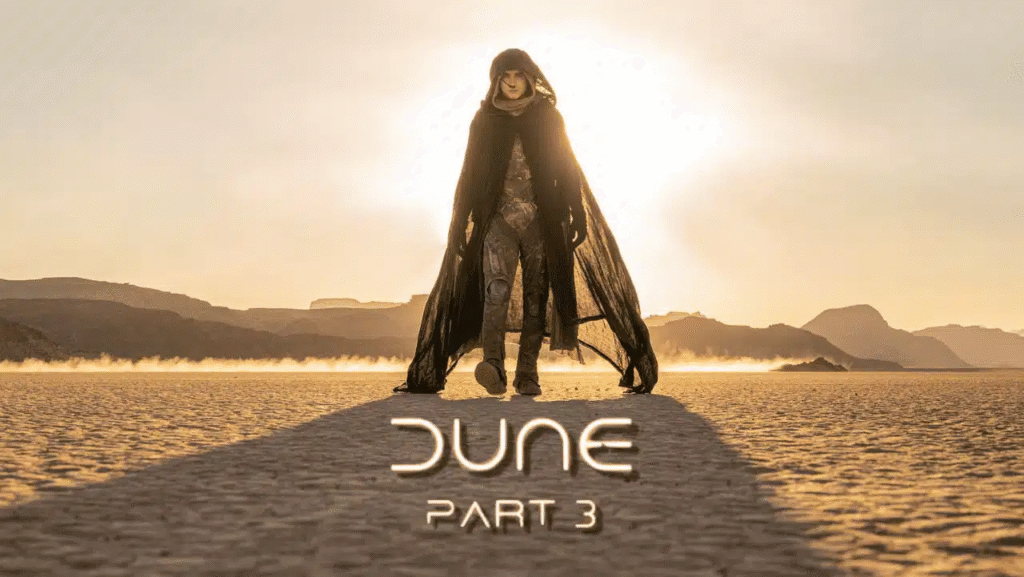
Dune: Part Three movie 2026 is shaping up to be far more than just another entry in a sci-fi saga—it feels like the culmination of everything Denis Villeneuve has been building toward since the first frame of Arrakis was revealed. This is a story where triumph and tragedy blur together, where every so-called victory leaves behind emotional ruin, and where the line between savior and destroyer becomes impossible to distinguish. At the center of it all stands Paul Atreides, a man burdened by visions of every possible future, yet still unable to escape the path he is helping to create.
Villeneuve’s approach turns the epic into something intimate and unsettling, forcing audiences to sit with the uncomfortable idea that power, even when wielded with good intentions, can become catastrophic. As the final chapter arrives on December 18, 2026, it carries the weight of an ending meant to linger long after the credits roll. If the spice truly flows one last time, it won’t just close a trilogy—it will redefine it.
Do Follow Us On :: https://talkieflix.com.